Author: lucasyesaki (Page 1 of 2)

Free Inquiry 10: Thank You!

As I sit here creating my final inquiry post, I ponder a few things. The first question I have is, what was my goal with this project. Well, my goal with this project was to make myself a better golfer by holding myself accountable to actively attempt to improve. Did I improve? No. The answer is no. I would say parts of my game have taken strides while other parts have severely regressed. The parts that have improved over this semester have been my chipping and iron play. My irons used to be the worst part of my game as I could hardly hit them well but now they are the strongest part. My chipping has always been pretty consistent and it held the course and then some. My driver is a different story sadly. Through the summer I was able to stripe the thing and I had the most confidence in the world. Now I can’t even look at it. I’m scared to use it! Golf is such a weird sport because it is so hard to have all facets of your game going well at the same time. If my driver is solid, my irons are off. If my putting is dialled in, my chipping falls off a cliff. It is hard sometimes but I keep reminding myself that I’m not a professional and can not hold myself to such a high standard.

My second point of ponder stems from the project itself. Did I have fun with it and was it helpful? To answer the first part of that question, yes I had a ton of fun. It was a very unique project and the fact that it was low pressure and stretched the entire semester was very cool. I really liked how much freedom we had with it. We could basically do whatever we chose. For the second part, I think it was helpful in the fact that I was able to document parts of my golf game that were good or bad but I would’ve liked to have done more inquiry. It turned into more of a blog of sorts rather than an inquiry project but that’s ok.

In the end, I had a lot of fun with it and that’s all that matters.

Thanks for reading!
Free Inquiry 9: Slow-Motion Home Setup

I was unable to get out and play golf this weekend due to weather and other circumstances. However, my dad has set up this makeshift golf net in the basement. Before its repurpose, this area of our house was home to a hockey net where I would shoot pucks. That’s why there is plywood painted with “Yesaki Arena” on the back wall there. Now, since nobody in our house is practicing hockey, we put this net up and bought an artificial turf mat. In all honesty, I don’t find myself using it that often. Maybe that’s why I am regressing at golf, because I am not practicing enough.

In the videos, you can see a slow motion golf swing. The problem with hitting balls in the basement is that I am always worried in the back of my mind that I am going to hit the ceiling either on my backswing or my follow through. However, it is cool to see my swing in slow motion. Seeing the impact of the ball and watching it sail into the net is quite satisfying. In terms of the swing, I have this problem where my hands are much too close to my body when I am impacting the ball. You can see how compact everything is in these videos. I have had this problem for a while and I am not sure how to correct it. My ball striking is pretty solid in both clips.

Maybe I should start utilizing both the net and slow motion more to try and improve my game…

Free Inquiry 8: ChatGPT Help Me Please

I am desperate to fix this slice. So desperate that I wanted to get ChatGPT’s input on my current situation. I also was curious to see what it would say about golf. I often look to it for help with school related issues but never have I used it for a recreational topic.

I started with the prompt “Please help me fix my slice with the driver” and this is what it came back with:

Fixing a slice in golf can be challenging, but with focused attention on your swing mechanics and some practice, you can make improvements. Here are some tips to help you correct a slice with your driver:

Check Your Grip:

  • Ensure that your grip is neutral and not too strong (hands rotated too far to the right on the handle). A strong grip can promote an open clubface at impact, leading to a slice.

Stance and Alignment:

  • Check your stance and alignment. Your feet, hips, and shoulders should be parallel to the target line. If your body is open at address, it can contribute to a slice.

Ball Position:

  • Place the golf ball inside your left heel (for a right-handed golfer). A ball positioned too far forward can encourage an outside-to-inside swing path, resulting in a slice.

Swing Path:

  • Focus on an inside-to-outside swing path. A slice often occurs when the clubhead cuts across the ball from outside to inside. Practice making a more shallow and sweeping downswing.

Clubface Position:

  • Pay attention to your clubface position at impact. The face should be square to the target. If the clubface is open, it can lead to a slice. Practice squaring the face during impact.

Grip Pressure:

  • Maintain a relaxed grip pressure. Gripping the club too tightly can affect your wrist action and lead to a slice.

Wrist Position:

  • Avoid “casting” or releasing your wrists too early in the downswing. This can open the clubface and contribute to a slice. Focus on a delayed release.

Take a Slow Backswing:

  • A too-fast backswing can result in a rushed downswing, leading to a slice. Take a smooth and controlled backswing, allowing for better control on the downswing.

Practice with Alignment Aids:

  • Use alignment sticks or other aids on the driving range to ensure that your club is traveling on the correct path.
  1. Seek Professional Guidance:
    • Consider taking lessons from a golf professional. They can provide personalized feedback on your swing mechanics and guide you through specific drills to correct your slice.
  2. Record Your Swing:
    • Use video recording to analyze your swing. This can help you identify any issues with your mechanics that contribute to the slice.
  3. Patience and Persistence:
    • Correcting a slice takes time and consistent practice. Be patient and focus on making gradual improvements to your swing.

Remember, making significant changes to your swing may feel awkward initially, but with dedication to improvement and practice, you can develop a more consistent and accurate drive. If possible, consult with a golf professional for personalized guidance based on your specific swing characteristics.

What I find interesting is that these tips are actually legitimate. If you look at YouTube videos by people that claim to know what they are talking about, you get a lot of similar stuff. The one that really made me laugh is the headline that says “Seek Professional Guidance.” That is an instance where AI does not sound very human because it makes it sound like I need serious help for a serious problem. But the “Clubface Position” and “Swing Path” points are my problem and it is cool to see ChatGPT address that.

Free Inquiry 7: A Slice Solution?

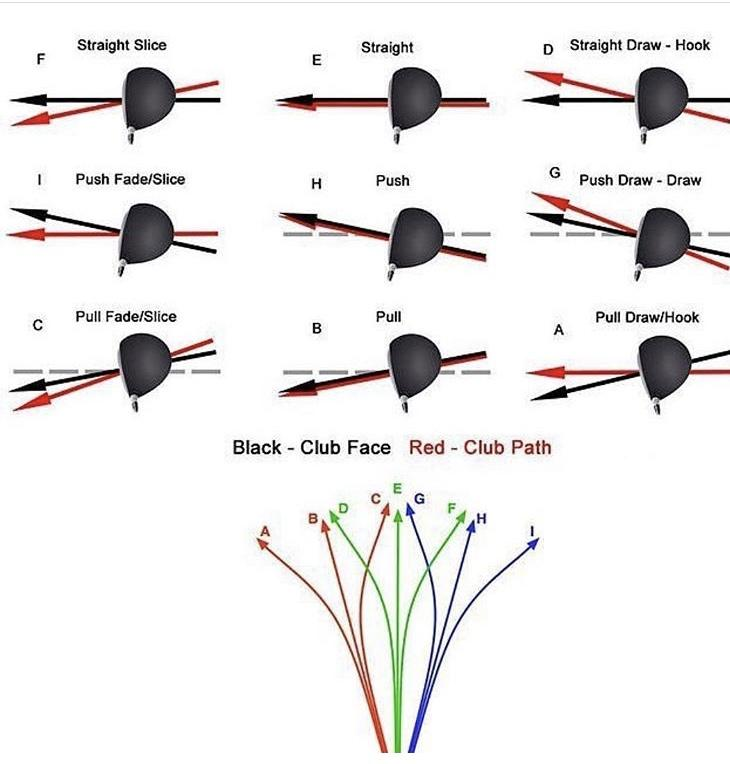
https://images.app.goo.gl/ae3WxNhx51TJKVUZ9

I have a serious slice problem with the driver. That has been well documented over the last 4 weeks or so. What is a slice? It’s a problem where the ball aggressively goes right off the club face after starting straight. It just starts to peel right and you lose a lot of distance. With this image you can see the different types of golf shots that can happen. I currently am operating under the F diagram that shows a slice. You can see the ball starts straight and then peels right. This is a result of the swing path. The swing path is the red line in this digram and you can see how it goes right. relative to the target line (black line). This type of action results in some wicked side spin that causes the slice. So my problem lays within my swing. I am swiping across the ball rather than hammering it dead straight relative to my target line.

The problem with golf is that you can fully know what your problem is and never be able to fix it. This can be due to lack of practice, not being skilled enough or simply not being able to play enough. It sure is a frustrating sport.

Weekly Reflection 8: Inclusivity

Today in class we were visited by Tracy and Kaori from BCEDaccess for a discussion about inclusion in education. More specifically we talked about some technology and how it can aid inclusion. To begin the class, Tracy did an exercise with sticky notes where she gave the majority of the class a pink sticky note, some of the class a green note, a small amount of orange notes and some people did not get a note. She further explained that pink notes meant we could stay, green meant they had to leave after a bit of time, orange meant they could stand in the hallway with supervision and no sticky note meant they had to leave right away and could not participate in class. We were all very confused, some questioned it while others (like Ben) just accepted it. Tracy clarified and said we were just participating in a demonstration of what some kids have to deal with in the school system and it was really eye opening. The idea of a kid not being able to participate in class activities simply because they lacked something that others had is a difficult concept to grasp. Instead of casting them to the side, the school system should be finding ways to better support them.

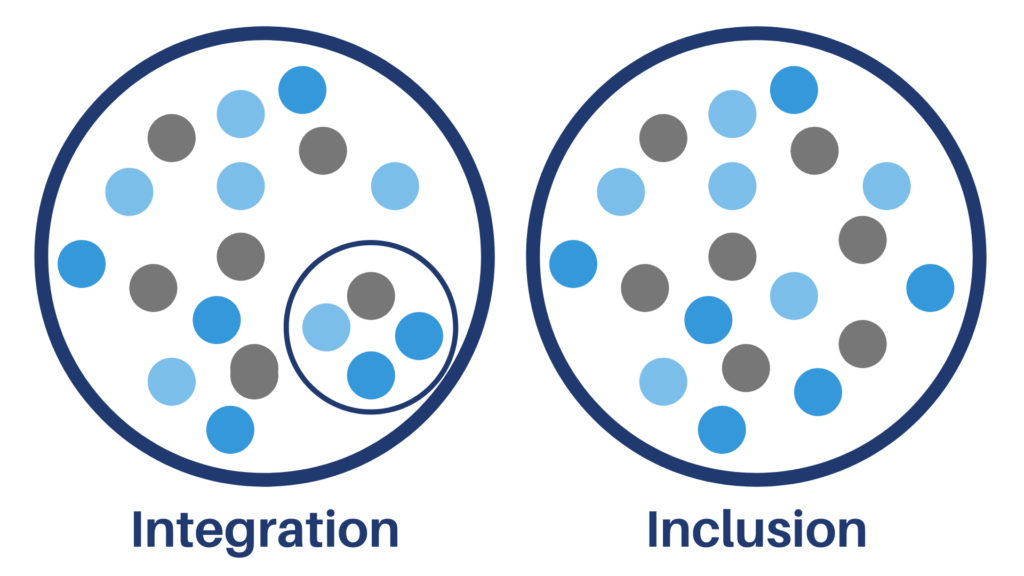
https://images.app.goo.gl/K28MRS2CkCineVwj9

I think of integration versus inclusion is important to discuss. It is important to note that although a student may seem like they are included in the class, they might not be. The image on the left shows the difference between the two terms. Getting a kid that has a designation into the classroom amongst others is an amazing feat and should in no way be discredited. However, we should not stop there. We should try our best to immerse the student in the class content and amongst their peers in order for them to be truly included. Yes, it may be a struggle but it is worth the effort in my opinion. On the flip side of the coin, there may be times where inclusion just may not be optimal for the student, for the rest of the class, and for the staff. In my Link2Practice class, we have a student who has autism and is hardly engaged with the class. There have been efforts to get him both integrated and included but it just is not working right now. The staff involved have taken note of this and are responding with appropriate methods that work for him such as taking time in support rooms, allowing him to leave the class and go for walks, or being in the class without being heavily involved. Although you would like to see him in the class everyday with his peers, it just is not optimal right now and that is okay.

All-in-all I am thankful for the presentation we received today from Tracy and Kaori. What made it memorable for me was how they seamlessly brought in their own personal stories about their experiences with inclusion. It made the presentation much more human and it allowed me to be more engaged.

Free Inquiry 6: Having Fun, Still Not Good at Golf

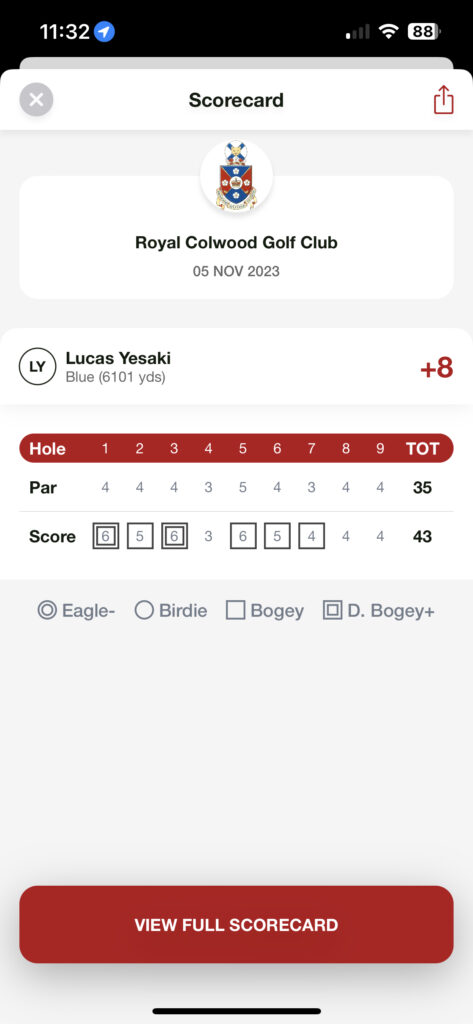
I played golf on Sunday and I had a lot of fun. I only played 9 holes because the time change has really dampened the ability to play 18 holes. With the sun setting at 5 o’clock, there is only so much time in the day.

As you can see by my scorecard, I really didn’t get off to a great start. Double bogey, bogey, and double bogey will never make anyone feel good. But I played the par 3’s really well. On both of the par 3’s I hit the green and had looks at birdie. Unfortunately I did not cash in. In fact on hole 7, I actually 3-putted and it cost me a bogey. Unreal. The whole round, my putting is what really cost me strokes and that needs to change. I used to be a solid putter and never really thought too much about it but now I’m abysmal. It might be because I’m over thinking it and I just need to get the ball towards the hole and minimize the 3-putts. Also, leaving putts short has been a problem. I need to get back to missing long to at least give it a chance at the hole. If you leave it short it will never even get the chance.

This is my friend Grady absolutely flushing a 9-iron on a par 3.

In terms of my clubs and how they performed, my driver is still terrible. I’m trying to swing more from the inside instead of over the top but I can’t figure it out. It’s getting demoralizing but still having fun! The irons were my best part and the short game was solid too. No complaints there. And I already talked about my putting.

Driver 5/10 Irons 8/10 Short Game 8/10 Putting 1/10

Weekly Reflection 7: AI

https://images.app.goo.gl/5zwaTuhCwkTDFwf19

In class today we focussed on AI and the uses it could have for us as teachers. Michael showed us some example prompts that we could feed into ChatGPT and in my opinion the most interesting one was the lesson plan prompt. He asked the program to design him some lesson plans for a specific topic and grade and almost instantly was given an entire lesson plan. Also, if he didn’t like what he saw originally he could just click regenerate and it would give him a brand new plan. It certainly does feel like cheating but if it is a resource that is available, it is hard to not take advantage.

I have talked to a few teachers about using AI and they have all given me similar responses. They say something along the lines of, “it has many great ideas, but I don’t see myself relying on it.” In my opinion, eventually AI is going to be a pretty common tool in the world just like how the internet became readily available for people back in 1993. So people are weary of using it and don’t want to admit to using it because they don’t want people to think they are “cheating.” Eventually, that misconception will fade away and people of all professions will be using AI to make their lives easier.

There was also a discussion about the ethics of AI. I raised a question about AI potentially displacing people out of their jobs. The example I used was somebody who has the job of helping you find resources in the library. Why would I go into the library when I could just ask ChatGPT and quickly get the job done. Another argument for AI in this case is that ChatGPT is free and accessible. Hiring an employee to do the job is not. So if I was an employer, I would ask the question of why would I be paying someone to do a job that a computer can do for free? I know that sounds harsh but it is a harsh world. Another interesting point that I often ponder is how are teachers going to make assignments knowing that students can just get ChatGPT to do it for them. Michael made a great point in saying a way around this is to get kids to inject a human element into their projects. Human elements such as their own experiences, opinions or emotions. I never thought about that and will keep it in mind going forward.

Weekly Reflection 6: Multimedia Learning

I think today’s class was one of the most enjoyable classes I’ve sat in all semester. We started with a bit of a summary of what we did with Rich two weeks ago where we talked about ways to incorporate multimedia into our teachings to potentially make them more engaging. An example was finding a balance between pictures and words for a slide. Michael started to explain how to properly use a bicycle pump. The first method he used was a boring looking paragraph that step for step explained how to use the pump. No pictures were included, just words. That was not very effective. He then showed a picture of just a bicycle pump that was still in the packaging and that wasn’t great either because it was not engaging. The final attempt included a step by step diagram of a pump in action with descriptive text on the diagram. I found this to be a perfect and informative balance between text and picture. It was easy to follow the different steps of the pump but also I wasn’t overwhelmed with words. This part of the class was incredibly relatable as a university student. I have sat through classes where we just sit there and listen to the professor read off of a word document that only features words. It is by far the least engaging way to teach a class. We then moved on to see the power of PowerPoint and how it can be more than just a presentation tool.

We played around with the different tools and I had a lot of fun with it. I can totally see how kids would be able to use this. An example I thought about was students making a story and including themselves in it. They could easily grab backdrops off of the internet and post them into a PowerPoint all well including different pictures as the characters or the main focus. I think this might be too advanced for younger students but for students in grade 7 or 8 they would be able to figure this out. It is also very easy to teach. Michael showed us how to do it on the projector and I figured it out rather quickly.

The potential for easily making worksheets is there too. Some of our classmates took a more serious route and developed incredibly easy math worksheets using a few images. This is pretty cool to me as I won’t have to always rely on borrowing other teacher resources but I can just hop on to power point and quickly make a worksheet.

Free Inquiry 5: Frost in October

I have not been able to get out to play golf lately. I was really looking forward to playing fall golf as this is a time when golf courses start to soften up after the summer and regain some green. However, each morning lately has seemingly been plagued by frost and frigid temperatures. And when there is frost in the morning, golf courses enter what is called a frost delay where all the tee times get pushed back and sometimes cancelled. I am also not really looking to get out and play golf when it is 5 degrees outside. Sure I could layer up, but I would rather just wait for the cold spell to pass. If it never passes then I’ll just get over myself and play in the cold. Here is the twitter account of the golf course I play at updating us on the status of the course:

https://x.com/RoyalColwoodGC/status/1717901005709529168?s=20

From YouTube, Golf Monthly

I found this YouTube video that includes some solid tips for how to brave the cold on the course. They talk about simple things such as wearing a base layer on the course and even buying one of those hand warmers that quarterbacks wear in the NFL. The most interesting tip to me that was mentioned was how you need to put your ego out of the way and club up. What do I mean by that? Well in the cold air, the golf ball is guaranteed to travel a shorter distance versus the summer air. So the guy in the video suggests that although it might be slightly embarrassing, for the best results you need to hit a longer club than you might normally to account for the loss of distance. That isn’t something I’ve given much thought in the past but will keep it in mind going forward.

Hopefully I will be able to get out to play a little bit next weekend so I have more to share.

Weekly Reflection 5: Kirsten and Nature

Today in class we had a guest speaker named Kirsten come in. Some of the things she discussed were very interesting. The first topic was how can we integrate technology into learning about the environment and eco-literacy. When she originally proposed this question, I was a little bit overwhelmed. I figured she wanted us to solve this massive issue just off the top of our heads but it wasn’t like that at all. She gave some examples and they were all very simple. The most simple being simple photography and video. Getting kids to go out into their environments and capturing the places they live and study in. She also brought up Minecraft and how that can be used as a tool to teach kids about different wildlife and biomes. Considering how excited kids get for Minecraft, I figure this could be a great resource. Google Earth was also mentioned and how you are able to rewind the maps to 10 or so years ago to see the development of the land.

Kirsten also brought up the concept of two lense learning. From what I understood, it is essentially looking at something in the world from the western point of view, but also considering a different culture’s point of view. The example that we discussed in class was an Indigenous point of view. For me as a settler, a tree will appear to just be a tree. It has bark, it grows leaves, it loses it’s leaves and so on. But perhaps for an Indigenous person, that tree has a story and important cultural ties. Now I am not saying that for all of Western society that trees are just trees however I don’t think I know too many people who would be able to tell me something important to them or their family with regards to a tree. I think that this type of learning is very important to be teaching students because it is important for them to understand that there are other world views outside of what they know. We need to be more cognizant of other cultures and their ties to the land.

Towards the end of class we ventured out to Finnerty Gardens to take in the environment and to think of ways that we could tie technology into the land. For me, it was pretty cool to head into the gardens and to see the different trees and bushes labeled. I read some names of plants that I had never heard of before so that was pretty cool. Michael then showed me how Google Lense works by taking a picture of a plant and running it through Lense. That would be a very cool thing for students of all ages to be able to do. To head out to their place of learning and photograph something that interests them and identify it would be awesome and maybe there is a sense of accomplishment there. Additionally, going into an environment like that progressively throughout the seasons would be beneficial for students as they would be able to see the same plantlife throughout the year and how it changes with the seasons

« Older posts

© 2026 Golf with Lucas

Theme by Anders NorenUp ↑